- The WA-AB Auto Corridor: A Strategic Advantage for Dealerships
- Navigating the Border: Key Customs & Compliance Checkpoints
- Essential Documentation for Seamless Fleet Imports
- Understanding Duties, Taxes, and Brokerage for Inventory
- Protecting Your Assets: Transport Methods for Dealership Vehicles
- Open vs. Enclosed Carriers: A Strategic Choice for Dealers
- The Role of Technology in Real-Time Inventory Tracking
- Streamlining Your Logistics: Partnering for Efficiency & ROI
- FAQ: Washington to Alberta Vehicle Transport for Dealers
The WA-AB Auto Corridor: A Strategic Advantage for Dealerships
For savvy car dealership owners and inventory managers in Alberta, the Washington state auto market represents a significant competitive advantage. Access to major US auction houses, a diverse range of pre-owned models, and unique fleet opportunities can dramatically enhance your inventory mix and profitability. However, capitalizing on this opportunity requires more than just a winning bid; it demands a mastery of logistics. Efficient and compliant cross-border dealership inventory vehicle transport from Washington to Alberta is not merely a shipping task—it’s a critical component of your operational strategy that directly impacts inventory turnover, asset protection, and your bottom line. This guide serves as your strategic manual for transforming this complex logistical challenge into a seamless, profitable part of your business model, powered by the expertise and technology of Optixtrace Logistics.
Navigating the Border: Key Customs & Compliance Checkpoints
The US-Canada border is the longest international border in the world, and while it facilitates immense trade, it is governed by strict regulations. For vehicle imports, failure to comply can result in costly delays, fines, or even seizure of your assets. A proactive approach to customs and compliance is non-negotiable. This involves understanding the specific requirements of both the U.S. Customs and Border Protection (CBP) for exports and the Canada Border Services Agency (CBSA) for imports. Every vehicle in your shipment must be cleared correctly, with all electronic filings submitted accurately and on time through systems like the Automated Commercial Environment (ACE) and the Single Window Initiative (SWI).
Essential Documentation for Seamless Fleet Imports
Precision in paperwork is the bedrock of smooth cross-border vehicle transport. Delays are most often caused by incomplete or inaccurate documentation. For a fleet of vehicles moving from Washington to Alberta, your logistics partner must manage the following for each unit:
- Original Title / Certificate of Origin: This is the primary proof of ownership and must be presented to U.S. CBP at least 72 hours prior to export.
- Commercial Invoice: Details the buyer, seller, and the value of each vehicle. This is crucial for calculating duties and taxes.
- Bill of Lading (BOL): The legal contract between the shipper (your dealership) and the carrier, detailing the terms and conditions of transport.
- Transport Canada Vehicle Import Form (Form 1): This form must be completed for each vehicle being permanently imported into Canada.
- Registrar of Imported Vehicles (RIV) Program Compliance: Most vehicles must be registered with the RIV program to ensure they meet Canadian safety and emissions standards. Evidence of recalls being closed is often required. You can check vehicle admissibility on the official Transport Canada site.
Optixtrace’s expertise in Cross-Border Logistics ensures every document is meticulously prepared and filed correctly, preventing your valuable inventory from being held up at the border.
Understanding Duties, Taxes, and Brokerage for Inventory
The financial aspect of importing vehicles extends beyond the purchase price and transport fees. A clear understanding of the landed cost is essential for maintaining your margins. Key financial considerations include:
- Goods and Services Tax (GST): Upon entry into Canada, GST (currently 5%) is payable on the value of the vehicles.
- Duties: While vehicles manufactured in North America are generally duty-free under CUSMA (Canada-United States-Mexico Agreement), vehicles manufactured elsewhere may be subject to a 6.1% duty.
- Green Levy (Excise Tax): Certain fuel-inefficient vehicles may be subject to an excise tax.
- Customs Brokerage Fees: A licensed customs broker is essential for preparing and submitting the complex customs release documentation. This fee covers their expertise in classifying goods and managing the clearance process with the CBSA.
Partnering with Optixtrace Logistics means this entire process is managed for you. We provide transparent, all-in cost structures so you can accurately forecast your total investment per unit.
Protecting Your Assets: Transport Methods for Dealership Vehicles
Once compliance is handled, the physical safety and security of your inventory during transit is paramount. The method of transport you choose should be a strategic decision based on vehicle value, volume, and seasonal weather conditions along the Washington-to-Alberta corridor.
Open vs. Enclosed Carriers: A Strategic Choice for Dealers
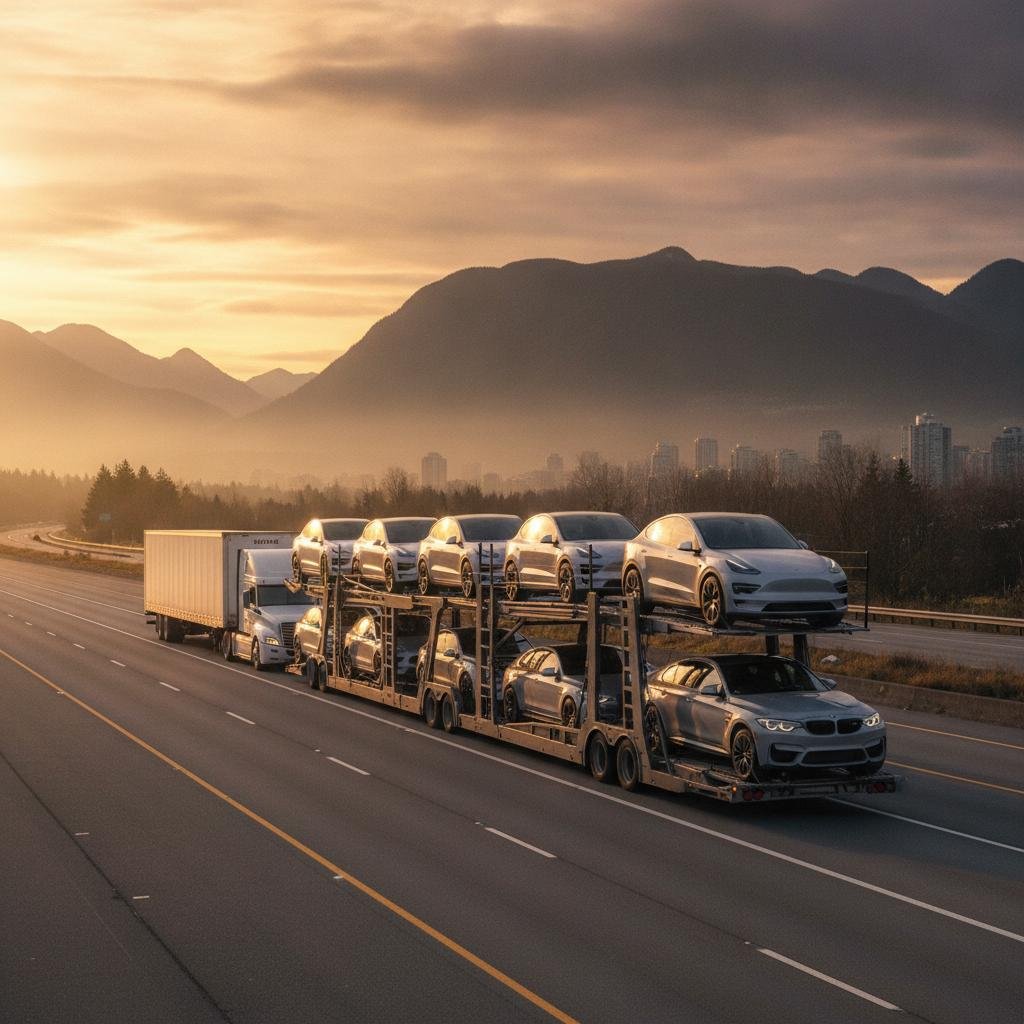
Optixtrace offers both primary methods of Auto Transport, allowing you to tailor the solution to your specific inventory needs. The choice between open and enclosed carriers is a balance of cost, protection, and vehicle type.
| Feature | Open Carrier Transport | Enclosed Carrier Transport |
|---|---|---|
| Cost | More cost-effective, ideal for standard inventory and managing transport budgets. | Premium service, reflecting a higher level of protection. |
| Protection | Vehicles are exposed to weather and road elements. Suitable for most standard sedans, SUVs, and trucks. | Fully protected from weather, debris, and potential road hazards. |
| Best For | Bulk transport of used inventory, standard models, and budget-conscious fleet moves. | High-value luxury vehicles, classic cars, new inventory, or vehicles requiring pristine condition on arrival. |
| Capacity | Typically carries 8-10 vehicles, offering economies of scale. | Lower capacity (1-7 vehicles), providing more focused service. |
Our team works with you to develop a blended strategy, potentially using open carriers for the bulk of your inventory while reserving Enclosed Auto Transport for your high-end units, optimizing both budget and asset protection.
The Role of Technology in Real-Time Inventory Tracking
In modern inventory management, information is as valuable as the asset itself. Knowing precisely where your vehicles are is no longer a luxury—it’s an operational necessity. Optixtrace’s commitment to Digital Transparency & Real-Time Tracking provides you with a live, 24/7 view of your shipment. This technology empowers your team to:
- Optimize Sales Cycles: Accurately predict arrival times to pre-sell incoming inventory and reduce on-lot time.
- Enhance Security: Monitor the exact location of your high-value assets from pickup to delivery.
- Improve Planning: Coordinate staff for vehicle intake, detailing, and lot placement with precise ETA data.
- Increase Transparency: Share tracking information with stakeholders and build trust in your operational efficiency.
Streamlining Your Logistics: Partnering for Efficiency & ROI
Managing multi-vehicle, cross-border shipments is a full-time job that can divert your focus from your core business of selling cars. Partnering with a specialized logistics provider like Optixtrace Logistics consolidates all the complexities into a single point of contact. We leverage our Vetted Professional Carrier Network to ensure every driver and piece of equipment meets stringent safety and insurance standards set by bodies like the FMCSA. Our Guaranteed Pickup Service provides schedule reliability, allowing you to plan your inventory flow with confidence. By integrating expert customs brokerage, optimized carrier selection, and cutting-edge tracking technology, we deliver a holistic solution for cross-border dealership inventory vehicle transport from Washington to Alberta that is designed to maximize your return on investment. Our comprehensive North American logistics services, including **Drayage Services** for vehicles arriving at ports, ensure a seamless supply chain from any source to your dealership lot. Discover the Optixtrace advantage at https://optixtrace.com/.
FAQ: Washington to Alberta Vehicle Transport for Dealers
- How long does cross-border dealership inventory vehicle transport from Washington to Alberta typically take?
- Standard transit time is typically 2-4 days from pickup in Washington to delivery in Alberta. However, this can be affected by factors such as weather conditions, specific routing, and the time required for customs clearance at the border. Optixtrace’s real-time tracking provides precise ETAs throughout the journey.
- What is the Registrar of Imported Vehicles (RIV) program and how does it affect our inventory?
- The RIV program is a mandatory Canadian program that ensures imported vehicles meet Canadian safety standards. Before shipping, you must verify each vehicle is admissible and be prepared to complete the RIV registration and inspection process upon its arrival in Canada. Optixtrace helps you navigate these requirements to ensure your vehicles are compliant and ready for sale.
- Is our vehicle inventory insured during transport?
- Absolutely. Every carrier within the Optixtrace Vetted Professional Carrier Network maintains comprehensive cargo insurance to protect your assets from pickup to delivery. We verify all insurance policies to ensure they meet our high standards for your peace of mind.
- Can Optixtrace handle large, multi-vehicle shipments from auctions?
- Yes. We specialize in coordinating multi-vehicle shipments for dealerships. We can arrange for multiple open or enclosed carriers to efficiently transport your entire auction purchase. Our Guaranteed Pickup Service ensures that vehicles are collected promptly, minimizing storage fees and accelerating your inventory turnover.