
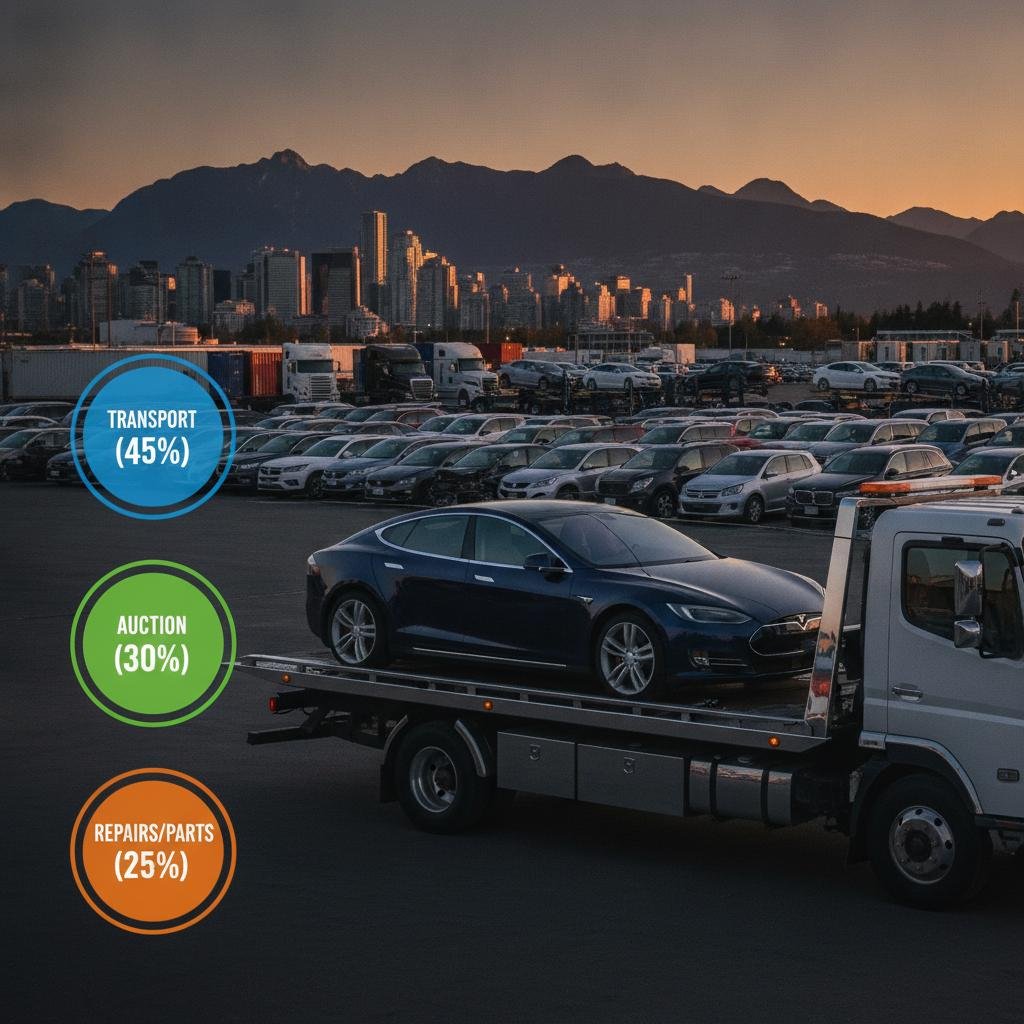
Winning a bid on a non-running or salvage vehicle at a Copart auction in the USA can feel like a major victory for any Canadian buyer, mechanic, or dealership. The price is right, and the potential is huge. However, the path from the auction lot to your Canadian doorstep is paved with potential financial surprises. Vague quotes and surprise fees can quickly erode your great deal. This guide serves as your definitive hidden fee buster, designed to provide a transparent, comprehensive breakdown of the all-inclusive cost for shipping a non-running car from Copart to Canada. At Optixtrace Car Shipping, we believe in empowering our clients with knowledge, leveraging our tech-forward platform to deliver not just vehicles, but clarity and peace of mind.
Your Complete Financial Roadmap for Copart to Canada Shipping
Calculating the true landed cost of an auction vehicle requires looking beyond the initial transport quote. It’s a multi-layered financial equation involving transport logistics, auction-specific charges, and cross-border customs compliance. Think of this not as a list of prices, but as a financial roadmap. By understanding each component, you can confidently budget for your import, ensuring your project remains profitable and predictable. We’ll dissect every potential charge, from the carrier’s winch fee to the final duties and taxes, putting you in complete control of your budget.
The Core Quote: What’s Included in a Base Transport Fee?
The first number you receive is the base transport fee. This is the foundational cost for moving the vehicle from the Copart auction location to your specified address in Canada. It typically includes:
- Line Haul Cost: The fundamental charge for transportation, based on distance, route, and vehicle size/weight.
- Fuel Surcharge: A variable fee that fluctuates with current diesel prices.
- Insurance: Carrier liability insurance that covers your vehicle while in transit.
At Optixtrace Logistics, our quotes provide a clear baseline for either Open & Enclosed Auto Transport, depending on your vehicle’s needs and your budget. This core fee is the starting point, but for a non-running vehicle, it’s only part of the story.
The ‘Non-Running’ Premium: Unpacking Winch and Handling Fees
A vehicle that cannot be driven onto the transport trailer under its own power is classified as non-running or inoperable. This status immediately triggers additional fees because it requires specialized equipment and extra labor. The primary cost here is the Winch Fee. A winch is a motorized, cabled device mounted on the transport truck used to pull the vehicle onto the trailer. This fee covers the use of the equipment, the additional time it takes the driver to safely load and secure the vehicle, and the increased risk involved. Expect this premium to be a standard, non-negotiable part of any quote for an inoperable vehicle. Failure to disclose a vehicle’s non-running status upfront will result in unexpected fees upon pickup.
Crossing the Border: A Breakdown of Customs, Duties, and Taxes
This is where many first-time importers encounter significant, unexpected costs. These fees are set by the Canadian government and are non-negotiable. With our deep Expertise in Cross-Border Customs Regulations, Optixtrace ensures you’re prepared for these mandatory charges:
- Duty: For vehicles manufactured outside of North America, a 6.1% duty is typically applied to the vehicle’s value in Canadian dollars.
- Registrar of Imported Vehicles (RIV) Fee: A mandatory fee required to ensure the vehicle meets Canadian safety and emissions standards.
- Air Conditioning Excise Tax: A $100 CAD tax if the vehicle has air conditioning.
- Goods and Services Tax (GST) / Harmonized Sales Tax (HST): You will be required to pay the GST (5%) or the applicable HST for your province on the total value of the vehicle plus duties.
For the most current rates and regulations, it’s always best to consult the official Canada Border Services Agency (CBSA) website.
Beyond the Freight Bill: Uncovering Ancillary Costs
The true all-inclusive cost for shipping a non-running car from Copart to Canada extends beyond the carrier’s invoice and government taxes. Several other “ancillary” costs are critical for accurate budgeting. These are fees charged by the auction house and the customs broker that are essential to the import process.
Navigating Copart: Storage, Loading, and Release Fees
Copart operates on a strict timeline. Once you win a bid, the clock starts ticking. The most common and costly surprise fee is storage. Copart typically provides a few business days to retrieve the vehicle before daily storage fees begin to accrue, and these can add up rapidly. This is where Optixtrace Logistics provides a critical advantage. Our Guaranteed Pickup Service, supported by a Large Fleet of Drivers and Dedicated Routes Every Week, ensures your vehicle is collected promptly, preventing these expensive and avoidable charges. Additionally, Copart will charge a Loading Fee to use their forklift or loader to move your non-running vehicle and position it for the transport truck driver to winch it aboard.
The Price of Paperwork: Brokerage and Import Documentation
Navigating the Canada-US border requires precise documentation. A professional customs broker is essential for a smooth crossing. Their fee covers:
- Preparing and Submitting Customs Declarations: Ensuring all paperwork is filed correctly with both U.S. Customs and Border Protection (CBP) for export and the CBSA for import.
- Managing Duty & Tax Payments: Collecting and remitting the required government fees on your behalf.
- Coordinating with the Carrier: Ensuring the driver has the correct documentation (PARS/PAPS) to cross the border without delay.
Optixtrace Car Shipping works with a network of trusted customs brokers, integrating this crucial step into our seamless Cross-Border Logistics (Canada-USA) service to prevent costly delays and administrative headaches.
From Auction Lot to Your Doorstep: A Sample Cost Journey
Let’s map out the process to illustrate how these costs come together. While every shipment is unique, this framework will help you build your own accurate budget.
Step 1: Pre-Purchase Budgeting
Before placing your bid, create a preliminary budget. This is your most powerful tool against surprises. Your checklist should include:
- Maximum Bid Price
- Copart Buyer & Auction Fees
- Estimated Transport Quote from Optixtrace Car Shipping (be sure to state the vehicle is non-running)
- Estimated Winch Fee
- Estimated Customs Brokerage Fee
- Estimated 6.1% Duty (if applicable)
- Estimated GST/HST on the total declared value
- RIV Fee & Air Conditioning Tax
Summing these estimates gives you a realistic target for your total investment before you even commit to the purchase.
Step 2: Post-Auction Logistics Coordination
Once your bid is successful, act immediately. Contact Optixtrace Logistics to finalize your booking. We will schedule the pickup to align with Copart’s release window, leveraging our Guaranteed Pickup Service to avoid storage fees. You will provide us with the vehicle title, bill of sale, and buyer information. From that moment, you can use our commitment to Digital Transparency & Real-Time Tracking to monitor your vehicle’s journey from the auction yard to the Canadian border.
Step 3: Final Import and Delivery Costs
As the vehicle arrives at the border, the final costs are calculated. Your customs broker will issue an invoice for the exact duties, taxes, and their service fee. Optixtrace will provide the final freight invoice. Your total landed cost will be the sum of: 1) The vehicle’s purchase price and auction fees, 2) The Optixtrace final freight bill, and 3) The customs broker’s invoice. With this clear, itemized accounting, you can be confident you’ve captured the complete financial picture.
Understanding the all-inclusive cost for shipping a non-running car from Copart to Canada is about diligence and partnership. By deconstructing the fees and planning for each stage, you transform a complex process into a manageable business transaction. Optixtrace Logistics is committed to being that transparent partner, providing the technology, expertise, and reliable service needed to make your cross-border vehicle import a success. Ready to eliminate the guesswork? Contact us today for a clear, comprehensive quote and experience the difference that digital transparency makes.